
Assessing turtle habitats with genomics

Project overview
Wildlife habitat assessments as part of environmental assessments are increasingly challenged by increased demand, narrow seasonal survey windows, and limited field capacity. These constrains are further amplified by monitoring of Species at Risk such as Wood Turtles, where regulatory processes can delay resource development and operational timelines. This has created an opportunity for complementary approaches that improve survey efficiency, while maintaining strong environmental protection standards.

Solution
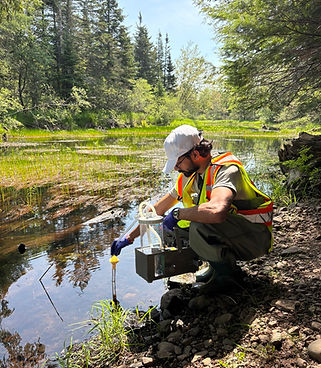
We are developing and validating a genomics-based turtle occupancy assessment tool that integrates environmental RNA (eRNA), environmental DNA (eDNA), and conventional field observations. In collaboration with Scotia Mine Ltd. and Strum Consulting, environmental water samples will be collected from the Gays River system near the Scotia Mine project area and analyzed using molecular approaches at the White Otter Biotech laboratory. By integrating molecular signals with field observations, this project aims to generate a quantitative framework for identifying recent turtle activity and validating genomics-based habitat assessments in real-world environmental monitoring contexts.

Impact
Genomics-based habitat assessment has the potential to strengthen environmental monitoring by reducing dependence on narrow seasonal survey windows, complementing labour-intensive field surveys, and allowing multiple survey approaches to be completed during a single field visit. By enabling more efficient and data-driven approaches for identifying sensitive wildlife habitats, this work can support regulatory decision-making while maintaining strong conservation outcomes. This project represents an important step toward demonstrating the application of genomics in environmental assessment programs and future wildlife monitoring initaitives across mining, forestry, and energy sectors.
